
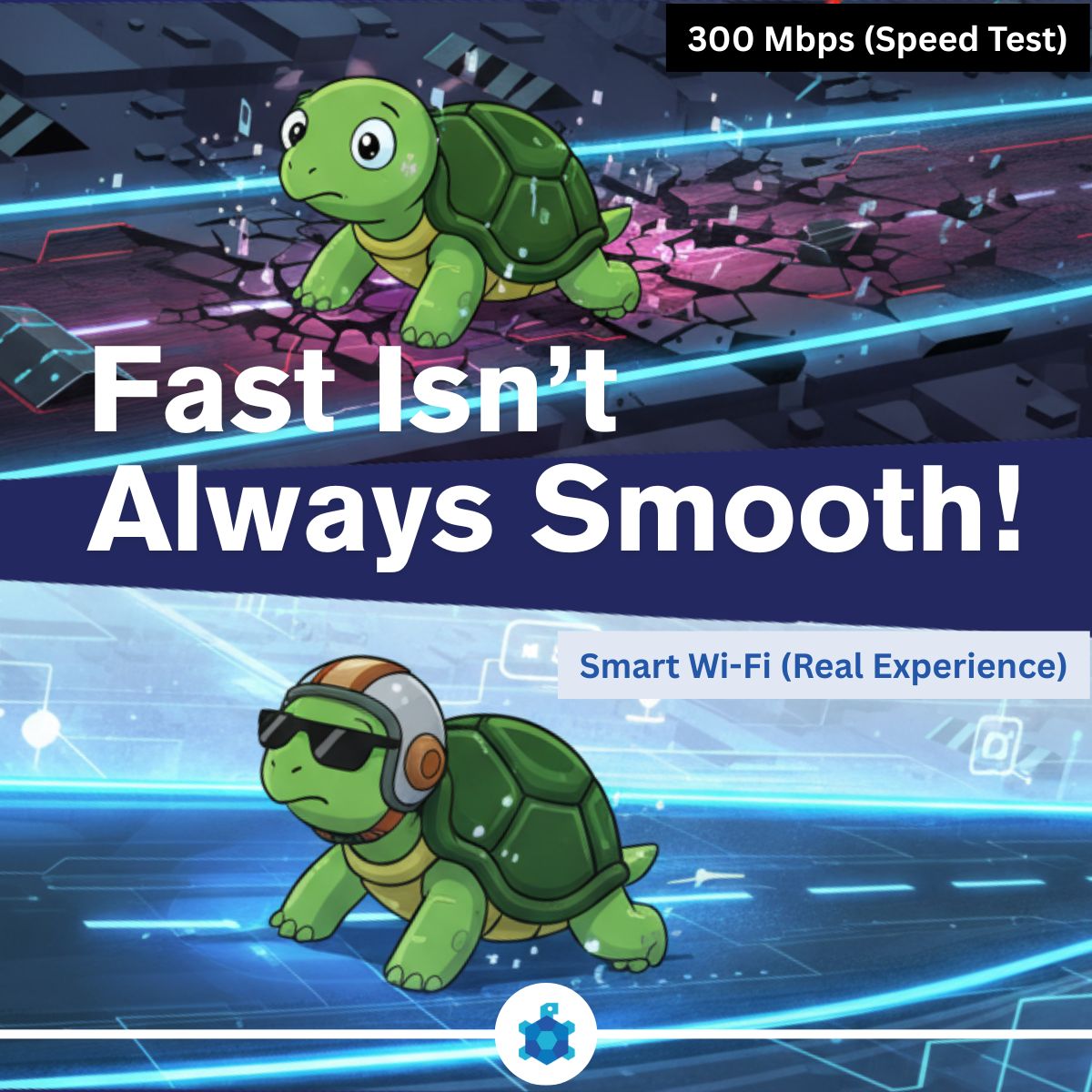
The Great WiFi Paradox: Why Speed Isn’t the Full Story
14 October 2025, 14:22
Your building has “blazing fast internet” on paper. The dashboard says 300 or more Mbps. The IT guy says everything looks great. And yet the tenants and visitors are grumbling about dropped Zoom calls and frozen video feeds like it’s 2011.
Welcome to the WiFi Paradox: when the speed tests pass but the experience still sucks.
Fast ≠ Good
Most buildings measure Quality of Service (QoS) e.g. signal strength, speed, and uptime. All very important. But what really matters is Quality of Experience (QoE): whether the WiFi actually works when someone’s on a call, streaming, or uploading that all-important pitch deck.
Spoiler alert: a great average doesn’t help when there’s a one-second spike that buffers a video call. That’s the difference between “Looks good!” and “My tenants are ready to riot.” 😉
What Really Affects WiFi Experience?
Let’s talk about the unglamorous but crucial villains of the WiFi world: latency and jitter.
- Latency = the time it takes for data to travel.
- Jitter = how wildly that time varies.
In real-world terms:
- High latency = weird delays in calls.
- High jitter = robot voices and frozen faces.
Even with high bandwidth, those two can make everything feel slow, glitchy, and unreliable.
Why Your Building Isn’t Helping
Here’s what makes commercial buildings uniquely challenging:
- Too many devices: Everyone’s got a phone, a laptop, and now IoT devices too. That’s a traffic jam waiting to happen.
- Thick concrete and metal: Great for stability. Terrible for signal strength.
- Interference: From your neighbour’s network, the lift motor, or even the microwave in the breakroom.
The result? Connectivity chaos.
What Actually Fixes This
It’s not more speed. It’s smart engineering. Here’s what makes the difference:
- WiFi 6 or better: Technologies like OFDMA and BSS Coloring are built for high-density environments.
- End-to-end design: Strategic access point placement, proper channel planning, and centralized control.
- Network segmentation: Keep guest WiFi, VoIP, digital signage, and critical building systems separated, so they don’t fight for airtime.
- Real traffic prioritization: Video calls should win over someone’s 10GB Dropbox sync.
But I Have 300 Mbps!
Yes. And that’s like saying your building has water. Doesn’t help if it only works in the lobby.
At FlatTurtle, we believe fast WiFi is good. But smart, stable, invisible WiFi? That’s the real goal.
If your tenants are grumbling even though your speed test says “great,” let’s talk. Because in 2025, “just fast” isn’t enough.
Stable and invisible is the brief for every network on our WiFi and internet page.
Let’s fix the paradox.