
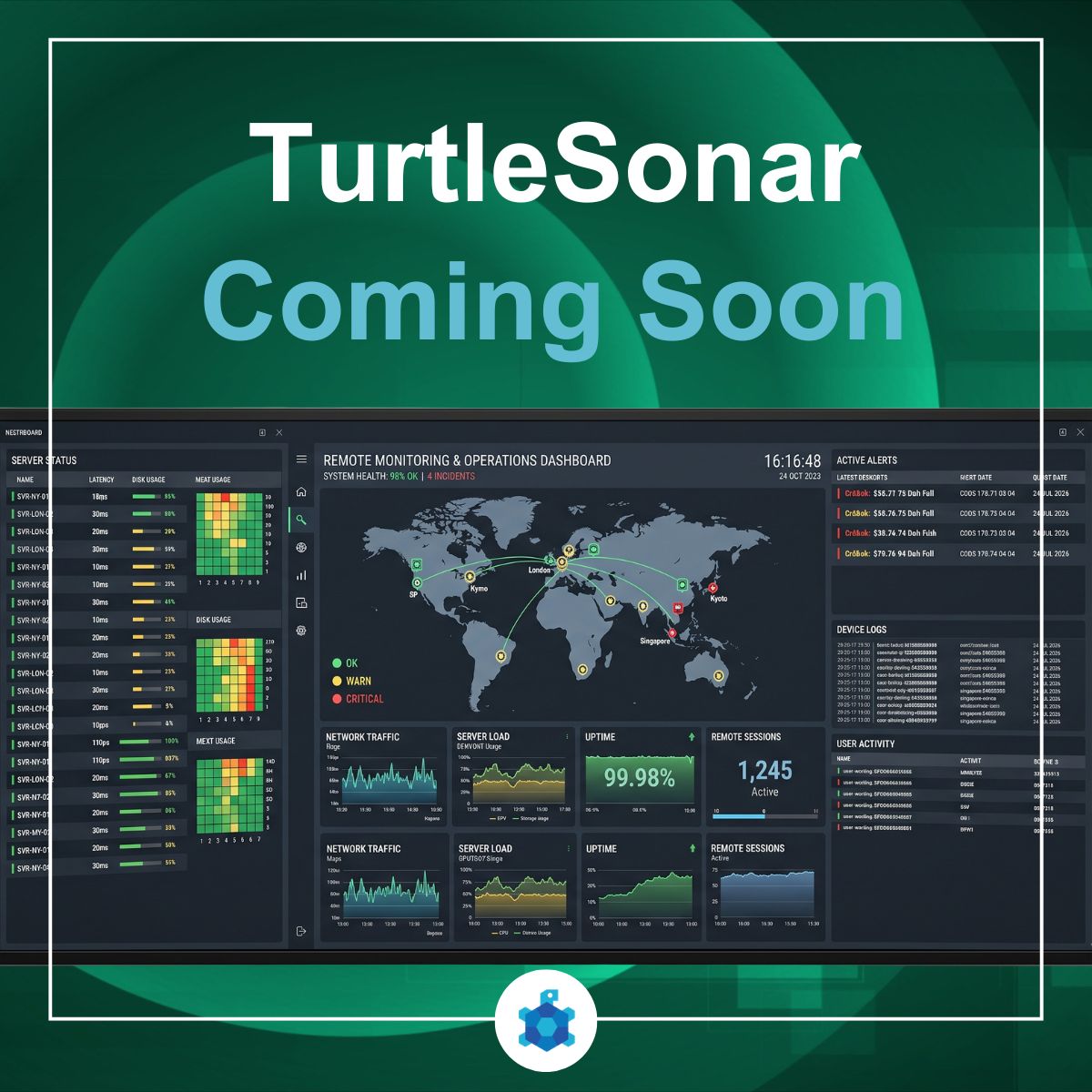
TurtleSonar: Keeping an Eye on the Building Systems Nobody Is Watching
11 August 2026, 09:30
Every modern building has a surprising number of systems quietly doing their job in the background. There are internet lines, door access systems, cameras, HVAC equipment, printers, servers, sensors, payment terminals, digital signage screens, and building management systems, all expected to work without drawing too much attention to themselves.
That is usually the ideal scenario. Nobody walks into a building hoping to think about whether the access control system is reachable, whether a printer has dropped off the network, or whether the building management system is responding as it should. These systems are meant to feel invisible because, when they work well, they simply support the smooth running of the space.
The problem begins when one of them quietly stops working.
A tenant cannot access the building. A reception team cannot print visitor badges. A meeting room display stops responding. A supplier discovers an issue only after someone complains. A facility manager is pulled into another round of “is it the internet, the device, the supplier, or the network?” troubleshooting, which is rarely the best use of anyone’s afternoon.
This is the gap TurtleSonar is being developed to address.
The Problem With Invisible Infrastructure
Buildings are becoming more connected, but that does not automatically make them easier to manage. In many commercial properties, different suppliers install and maintain different systems. One partner may be responsible for access control, another for cameras, another for HVAC, while other devices and applications are added over time to support tenants, visitors, operations, and shared services.
Each system may be important in its own way, but not every system is actively monitored. That means a device can drop offline, a service can stop responding, or a connection can become unstable without anyone noticing immediately. The first alert is often not a dashboard, but a tenant complaint.
For property teams, that creates a very familiar challenge. By the time an issue becomes visible, it may already be disruptive. What could have been a small technical warning becomes an urgent support request, and the building team is left trying to understand what happened, who owns it, and how quickly it can be fixed.
TurtleSonar is being built to make that situation less common.
A Practical Early Warning System for Buildings
TurtleSonar is a monitoring service designed to keep an eye on the equipment and connected systems inside a building, especially the things that are important but often not watched closely enough. The purpose is simple: if a device or service plays a role in how the building operates, it should not be able to disappear silently.
Instead of waiting for a tenant, receptionist, supplier, or facility manager to discover that something has stopped responding, TurtleSonar helps identify issues earlier. It can monitor whether key systems are reachable, track how they are behaving, and highlight when something appears to be offline or unusually slow.
For building owners and property teams, the value is not in adding another complicated technical platform. The value is in gaining clearer operational visibility. TurtleSonar is being designed to translate technical health into reporting that is easy to understand, so customers can see what stayed reliable, what had issues, when those issues happened, and whether there are patterns worth investigating.
In other words, it is less about filling a dashboard with blinking lights and more about giving property teams a calm, useful view of what is actually happening.
Less Guesswork, Faster Answers
One of the most frustrating parts of building technology is that the root cause of a problem is not always obvious. If a door access system stops responding, the issue could sit with the device, the supplier’s system, the local network, the internet connection, or even a small piece of hardware in a cabinet that nobody has looked at in months.
Without monitoring, everyone is often working from partial information. The tenant says something is broken. The supplier says their system should be fine. The internet provider says the line is up. The facility manager is left standing in the middle, trying to make sense of it all.
TurtleSonar helps reduce that uncertainty by giving the building team a clearer view of which systems are reachable and which ones are not. If a monitored device drops offline for a meaningful period of time, the right people can be informed. If the issue clears, that can be reflected too, so everyone understands whether the problem is ongoing or already resolved.
Good monitoring should also know when not to make noise. A brief blip does not always need to become a dramatic email chain. TurtleSonar is being shaped to avoid unnecessary alerts and focus attention on issues that actually matter, because nobody needs a system that behaves like an overexcited smoke alarm every time a device sneezes.
Built Around Real Building Needs
Every building has its own operational reality. A coworking space has very different expectations from a quiet office building. A retail hub has different risks from a site that mainly uses connectivity for sensors and basic infrastructure. A building with multiple tenants, payment terminals, meeting rooms, and shared services has a very different downtime threshold from a technical installation that only sends occasional data.
That is why TurtleSonar is not being developed as a one-size-fits-all monitoring tool. The intention is to understand what matters in each building, identify which systems are worth watching, and provide reporting that reflects the actual risk and expectations of that environment.
Over time, this kind of visibility can help property teams answer practical questions. Which systems are stable? Which devices regularly disappear from the network? Which suppliers may need to investigate recurring issues? Which incidents were isolated, and which ones point to a bigger pattern? Where does the building have hidden operational risk?
Those questions matter because reliable building technology is not only about fixing problems quickly. It is also about understanding where problems are likely to appear before they become tenant-facing.
Coming Soon
TurtleSonar is currently in development and being tested in real environments. The next step is to refine the service with selected customers, gather feedback, and shape it into something that is practical, understandable, and genuinely useful for property teams.
At FlatTurtle, we already provide connectivity, digital signage, and managed technology across commercial buildings, which gives us a strong foundation to help customers see more of what is happening inside their buildings. TurtleSonar is a natural next step: a way to bring better visibility to the systems that quietly support daily operations.
Because in building management, the best problems are often the ones you spot before tenants do.
TurtleSonar is coming soon.