
Connecting Buildings to the City: Why Reliable Transit Data Matters
4 May 2026, 09:04
Walk into a modern office lobby and you may see real time public transport information displayed alongside company announcements and meeting room schedules. It feels intuitive and helpful. Tenants can quickly check when the next train, tram, or bus is departing and adjust their plans accordingly. The information appears simple.
Behind that simplicity lies a more complex challenge.
Belgium’s public transport landscape is served by four major operators: SNCB-NMBS for rail, STIB-MIVB in Brussels, De Lijn in Flanders, and Le TEC in Wallonia. Each publishes schedule data in a standardized format known as GTFS. While the format provides consistency, the feeds themselves are dynamic. Schedules change, routes are adjusted, service calendars evolve, and data structures can be updated over time.
Displaying static schedules is easy. Ensuring that transit data remains accurate, validated, and continuously updated across multiple operators requires automation and monitoring.
To address this, we developed a GTFS data pipeline that automatically collects, validates, and stores transit schedule data from all four Belgian operators. The system runs as a containerized service on a daily schedule. It downloads the standardized feeds, validates their integrity, archives timestamped snapshots to cloud storage, and imports structured data into a relational database for querying. Error tracking and uptime monitoring are built into the process.
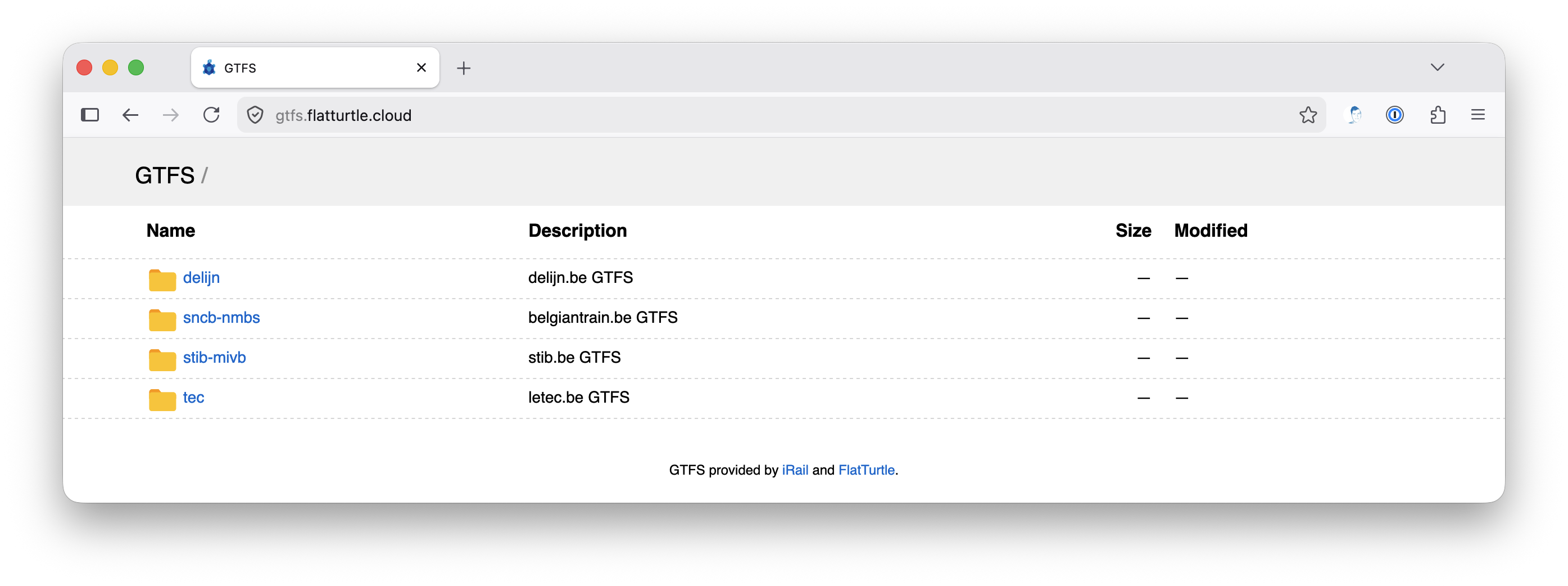
This architecture serves two purposes. First, it ensures that FlatTurtle’s products always have access to current schedule information, including routes, stops, trips, departure times, and service calendars (and we do not rely too much on live third party services). Second, by maintaining both a queryable database and a versioned archive, the system preserves historical data for auditing and analysis.
For building operators, this reliability translates into something tangible. Employees make better commuting decisions, and visitors can plan their onward journey without juggling apps. Surfacing public transport data also nudges people toward more sustainable choices; and when prospective tenants tour the building, it quietly reinforces a useful message: this place is well connected.
More broadly, integrating transit data into signage systems connects buildings to their urban environment. Instead of operating as isolated structures, they become context aware spaces that reflect what is happening beyond their walls. Real time data about mobility, weather, and local conditions enriches the overall experience.
The GTFS pipeline is publicly accessible, allowing others to use and build upon it. By sharing the project openly, we aim to contribute to a more interoperable ecosystem where building technology and public infrastructure interact more seamlessly.
As commercial real estate evolves, tenant expectations extend beyond connectivity inside the building. People increasingly value environments that support flexible commuting, sustainability goals, and real time information.
Reliable transit integration may appear to be a small feature on a lobby screen. In practice, it represents a broader shift toward buildings that are digitally connected not only internally, but also to the cities they inhabit.
At FlatTurtle, we see smart buildings as part of a larger urban system. Maintaining accurate, automated access to public mobility data is one step toward that vision.